Guides
Amazon MCP Explained: The Official Servers, the Connectors, and What Each One Can See
Amazon MCP means four things: the official Ads server, the Selling Partner plugin, AWS servers and third-party connectors. What each sees and can change.
 Dhiraj SoniFounder, OwnYourAMZ. Ex-Amazon.
- Published
- Updated
- Reading time
- 12 min read
Search "Amazon MCP" and you get four different things with the same name: Amazon's own Ads MCP server, a Selling Partner plugin for Claude, a set of AWS developer servers that have nothing to do with selling, and a dozen third-party connectors that borrow the term. This page sorts them out. For each kind: what it is, what it can see, whether it can change your bids, and who it is for. If you already know you want an Ads connector and want the ranked comparison, go straight to the Amazon Ads MCP shortlist.
Disclosure: we make OwnYourAMZ, one of the owned deployments described below. Every fact on this page comes from Amazon's or the vendor's own pages and is dated 27 October 2026.
Key Takeaways
- MCP is a standard, not a product. The Model Context Protocol is the open standard that lets an assistant like Claude or ChatGPT call tools. Anything called an "Amazon MCP" is a server that turns some Amazon API into tools the assistant can call.
- Amazon runs two official ones for sellers. The Amazon Ads MCP Server, in open beta since 2 February 2026, covers advertising only. The Selling Partner plugin for Claude, in beta since 23 September 2026, covers Seller Central for US stores only, with no advertising data.
- The official Ads server needs your own API credentials and stores nothing. You need an approved Amazon Ads API application, reports look back about 95 days, and there is no memory of what was changed or why.
- AWS MCP servers are not for sellers. They connect assistants to AWS cloud services. The Amazon shopping MCP lets an agent buy products. Neither touches Seller Central or your ads.
- Third-party servers differ on where your data lives. Hosted connectors (Marketplace Ad Pros, DataDoe, Agent Central, SellerMate, Helium 10, Nova) keep it on their servers. Kuudo and OwnYourAMZ keep it in an account you own.
What MCP Is, in One Paragraph
MCP stands for Model Context Protocol. It is an open standard for giving an AI assistant a set of tools it can call: read this report, update that budget, list these campaigns. An MCP server is the program that exposes those tools. You add the server's address to Claude, ChatGPT, Cursor or any other client that supports the standard, sign in once, and from then on the assistant can call the tools in the middle of a conversation. An "Amazon MCP" is any server whose tools wrap an Amazon API. Which API, and what the server keeps, is the whole difference between the options below.
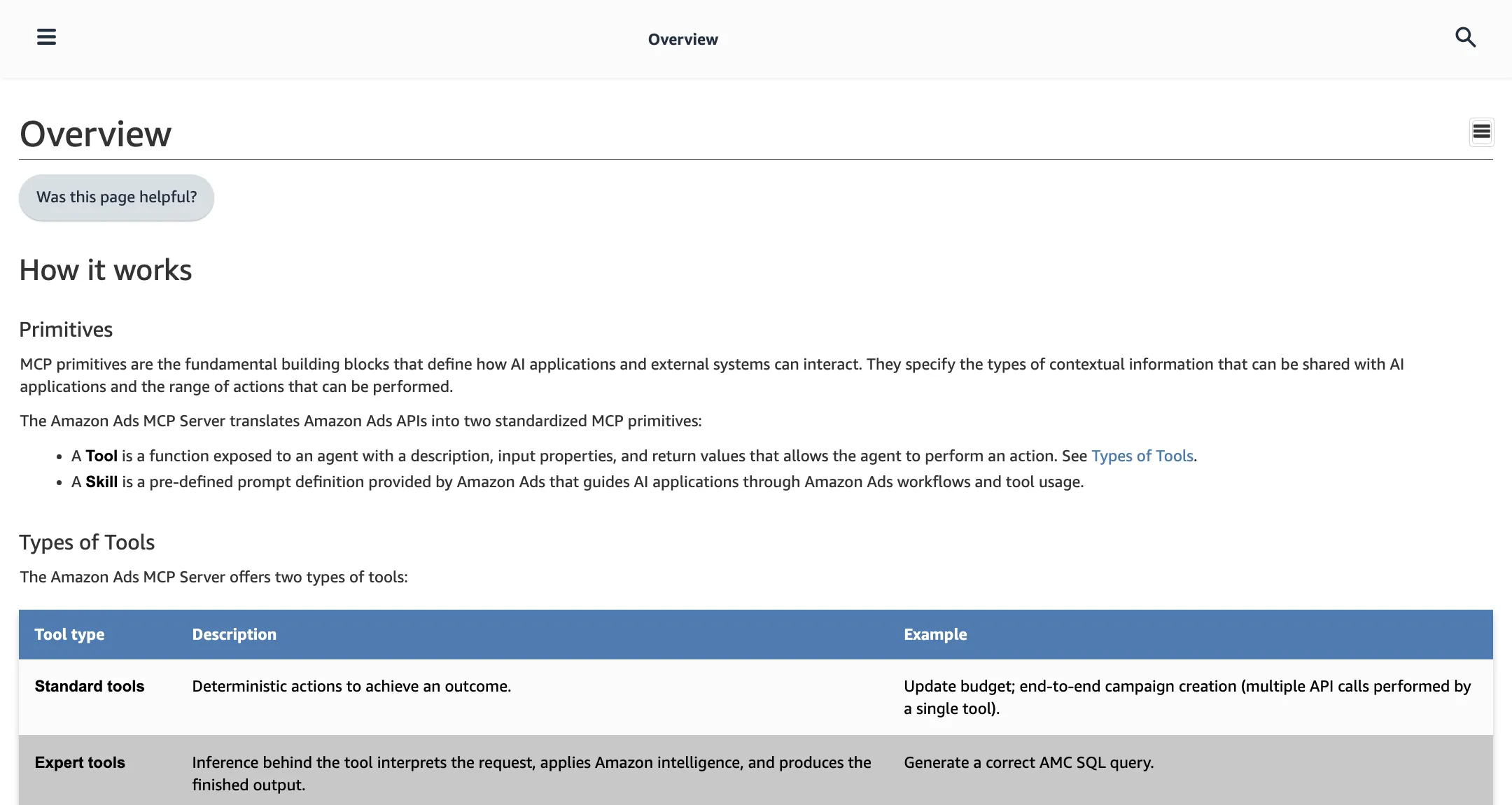
1. The Amazon Ads MCP Server (Official)
This is what most people mean when they search "Amazon MCP" after reading the news. Amazon Ads opened its MCP server to everyone with Ads API credentials on 2 February 2026, after a closed beta that started in November 2025. As of 27 October 2026 it was still in open beta and no fee had been published.
What it can see. Your advertising account: Sponsored Products, Sponsored Brands, Sponsored Display, Sponsored TV, DSP and Amazon Marketing Cloud. Kuudo's reading of the documentation counts 32 campaign-management tools plus reporting and AMC queries. It cannot see Seller Central, so no orders, inventory, fees or settlements. It stores nothing: every call goes through to the Ads API and comes back, which means reports look back about 95 days and there is no record of what was changed last month or why.
Can it change my bids? Yes. It can create, update and delete campaigns and change budgets and bids, and there is no built-in confirmation step. Any guardrail has to come from the client you connect it to, or from your own habit of asking it to show the plan first.
What you need. Your own Amazon Ads API approval (an application through the Direct Advertiser or partner track, which can take weeks) and a Login with Amazon app. The server has separate endpoints for North America, Europe and the Far East, and on public OAuth clients the access token expires after 1 hour, so the sign-in prompt comes back often. Amazon documents Claude Code, Claude Desktop, ChatGPT, Kiro and Amazon Quick as clients.
2. The Amazon Selling Partner Plugin for Claude
Announced at Amazon Accelerate on 23 September 2026 and listed in Claude's connector marketplace as made by Amazon, this is the Seller Central counterpart. It is in beta, for US stores only, with international expansion "to follow". No fee has been announced.
What it can see. Sales, inventory and listing performance from Seller Central, plus actions on inventory, prices, listings and FBA inbound shipments. It has no advertising data; Agent Central's test on 3 October 2026 reported the plugin returned none. So the two official options are complementary, not interchangeable: one sees ads, the other sees the store.
Can it change my bids? No, it has no ads tools. For the store actions it does have, every write goes through a review-and-approve step, which the Ads server does not have.
3. AWS MCP Servers and the Amazon Shopping MCP (Not for Sellers)
Half the results for "amazon mcp" are about these, which is why the term is confusing. AWS publishes a set of open source MCP servers and an AWS MCP Server that connect assistants to AWS cloud services: deploying infrastructure, querying databases, working with Bedrock. They are for developers building on AWS. Separately, there are community "Amazon MCP" servers on GitHub that let an agent search and buy products on amazon.com as a shopper. Neither kind touches Seller Central or Amazon Ads. If a page about "Amazon MCP" talks about Bedrock, Lambda or buying products, it is not about your account.
4. Third-Party Amazon MCP Servers and Connectors
Because the official Ads server stores nothing and needs API credentials most sellers do not have, a set of vendors built their own. They fall into two groups.
Hosted connectors. You sign in with Amazon through the vendor's approved app, the vendor pulls your Ads and usually your Seller Central data onto its servers, and you add the vendor's MCP address to Claude or ChatGPT. Setup takes minutes and there is no API application. Your data lives with the vendor. As of 27 October 2026: Marketplace Ad Pros (AI Connect at $10 a week or $39 a month, 90 days loaded at connect and kept after), DataDoe ($97 a month, about 2 years of history, hosted on AWS and GCP in the US), Agent Central ($39 to $159 a month by order volume, history from the day you connect), SellerMate (MCP free on every plan, 30 days of history on the free tier), Helium 10 MCP (Diamond plan only, $279 to $359 a month, reads Helium 10's own stored data) and Nova (from $49 a month, 24 months of history, read-only for ads).
Open source servers. Kuudo, made by Openbridge and MIT licensed, covers 1,139 Amazon API operations across Ads, the Selling Partner API and Vendor Central. You run it in your own AWS, GCP, Azure or Cloudflare account, and history lands in a data lake in your own storage. The Community tier is free with 10,000 API calls a month and your own Amazon app; it was in private beta when we checked. This is the "amazon mcp github" result people are usually looking for, and it needs an engineer.
Can they change my bids? Most can, and most put a check in front of it. Marketplace Ad Pros keeps writes off by default and confirms each change in an opt-in Edit Mode. DataDoe keeps writes off by default, enables them per action type, and has a dry-run mode. Agent Central previews every write and runs it only on an explicit confirm, logged with the value before and after. SellerMate passes writes through bid and budget guardrails with an optional approval queue and one-click undo. Nova cannot change campaigns at all. Helium 10 says "with approval" without describing the mechanism.
5. Owned Deployments
The last kind keeps the data in an account you control and runs the MCP server there. OwnYourAMZ is one: a small system deployed into your own Cloudflare account that pulls every Amazon Ads and Seller Central report once a day, keeps every day from the day you connect, and exposes all of it to Claude or ChatGPT through one MCP connection. Hosting costs about $5 a month, billed by Cloudflare to you, with no subscription and no percentage of ad spend. The Amazon connection runs through an approved app, so there is no API application, and setup takes about 14 minutes.
Can it change my bids? Yes, and only after you say so. Claude proposes a plan with counts, you approve, it applies the changes through Amazon Ads and logs each one with the value before and after. Rules you set, such as never pausing a hero product, override whatever it works out. The trade-offs: you need a paid Claude or ChatGPT plan, one deployment covers up to 3 Amazon profiles, and it is set up with you on a call rather than by self-serve checkout.
How to Connect Claude to the Official Amazon Ads MCP Server
If you already hold Ads API credentials, the official server is the quickest way to try MCP on your own account. The steps as of 27 October 2026:
- Get Amazon Ads API access. Create an Amazon developer account with the email on your Seller or Vendor account, create a Login with Amazon app, and apply for Ads API access as a Direct Advertiser (or a partner type if you manage client accounts). Approval can take weeks.
- Pick the endpoint for your region. North America, Europe and the Far East each have their own MCP endpoint, and they are not interchangeable. Use the one that matches the region of your ads account.
- Add it as a connector. In Claude, open the connectors settings and add a custom connector with the endpoint address. In Claude Code, add it as an HTTP transport MCP server. ChatGPT, Kiro and Amazon Quick have their own connector screens.
- Sign in through OAuth. The first connection opens Amazon's sign-in. On a public OAuth client the access token expires after 1 hour, so expect to sign in again often.
- Start read-only. Ask it to list campaigns and pull a search term report before you let it change anything. There is no confirmation step on writes, so ask for the plan first every time, or connect it through a client that enforces one.
Which Amazon MCP Should a Seller Use
Match the kind to the job. The full eight-way comparison with prices, history and write policies is in the shortlist; this table is the short answer.
| Kind | Sees | Changes bids | Data lives | Fits |
|---|---|---|---|---|
| Amazon Ads MCP Server (official) | Ads only, about 95 days | Yes, no confirmation built in | Amazon, nothing stored | Developers and agencies with API credentials who will add their own storage and guardrails |
| Selling Partner plugin (official) | Seller Central, US stores, no ads | No ads tools; store actions need approval | Amazon | US sellers who want store questions answered in Claude, alongside an Ads connector |
| AWS MCP servers, shopping MCP | AWS services, or amazon.com as a shopper | No | n/a | Not sellers |
| Hosted connectors | Ads plus Seller Central, 30 days to 2 years depending on vendor | Most, with a check | Vendor's servers | Sellers who want setup in minutes and accept vendor hosting |
| Open source (Kuudo) | Ads, Seller Central, Vendor Central | Yes, policy-gated | Your own cloud | Teams with an engineer who will self-host |
| Owned deployment (OwnYourAMZ) | Ads plus Seller Central, everything from the day you connect | Yes, plan then approve, logged | Your own Cloudflare account | Sellers and agencies who already pay for Claude and want to own the data |
Amazon MCP vs the Amazon Ads API
The Amazon Ads API is the raw interface: endpoints for campaigns, reports and billing that a developer writes code against, with OAuth tokens and rate limits. An MCP server wraps that API so an assistant can call it in plain language, with no code written by you. Every Ads MCP on this page, official or not, sits on the same API. What they add on top is the difference: whether anything is stored, how much history you get, whether Seller Central sits next to the ads data, and whether a change needs your approval before it lands.
Frequently Asked Questions
What is Amazon MCP?
MCP is the Model Context Protocol, an open standard that lets an AI assistant call tools. An Amazon MCP is any server that wraps an Amazon API in those tools. For sellers the two official ones are the Amazon Ads MCP Server, for advertising, and the Selling Partner plugin for Claude, for Seller Central. AWS also publishes MCP servers for its cloud services, which are unrelated to selling.
Is the Amazon Ads MCP server free?
Amazon has published no fee for it as of 27 October 2026, and it is in open beta. You do need your own Amazon Ads API approval, which is free but can take weeks, and a Claude or ChatGPT plan on the other end.
Does Amazon MCP work with ChatGPT?
Yes. Amazon documents ChatGPT alongside Claude Code, Claude Desktop, Kiro and Amazon Quick for its Ads server. Most third-party connectors list both Claude and ChatGPT, and several add Cursor and Gemini. The Selling Partner plugin is listed in Claude's marketplace.
Can the Amazon MCP see Seller Central?
The official Ads server cannot; it sees the ads account only. The Selling Partner plugin sees Seller Central sales, inventory and listings for US stores but has no advertising data. Third-party connectors such as DataDoe, Agent Central and Marketplace Ad Pros, and owned setups such as OwnYourAMZ, put both in one connection.
Is there an Amazon MCP on GitHub?
Yes, several. Kuudo's amazon_ads_mcp is the most complete open source Amazon Ads server, MIT licensed with 74 stars when we checked, and runs in your own cloud. Other repositories cover the Selling Partner API or let an agent shop on amazon.com. Amazon's own Ads server is hosted by Amazon and is not on GitHub.
Can an Amazon MCP change my bids and budgets?
The official Ads server can create, update and delete campaigns and change bids with no built-in confirmation step. Most third-party connectors keep writes off by default or preview and confirm each change. OwnYourAMZ proposes a plan with counts and changes nothing until you approve it. Check the write policy before connecting anything to a live account.
What is the difference between Amazon MCP and the Amazon Ads API?
The API is the interface developers code against. An MCP server wraps it so Claude or ChatGPT can call it in plain language. All Ads MCP servers use the same API underneath and differ in what they store, what else they connect, and whether changes need approval.
Is it safe to connect my Amazon account to an MCP server?
Connecting through Amazon's own OAuth, with your approved app or a vendor's, is the sanctioned route, and Amazon published its own servers for exactly this use. The risks are a vendor holding your data and an assistant making changes without a check. Prefer options that keep data in your account or state their retention, start read-only, and keep writes behind an approval step.
Get the Owned Version Running on Your Account
If you want the kind that keeps the data in your own account, we set it up with you on a call: the sync and the MCP server deployed into your own Cloudflare account, every Amazon profile connected through the approved app, the backfill run while we talk, and your first rules written together. Setup is free for the next 3 accounts. The application is about ten questions and takes two minutes, and a person reads it and replies within one business day. Get your setup and bring the account you most want to see it on.